

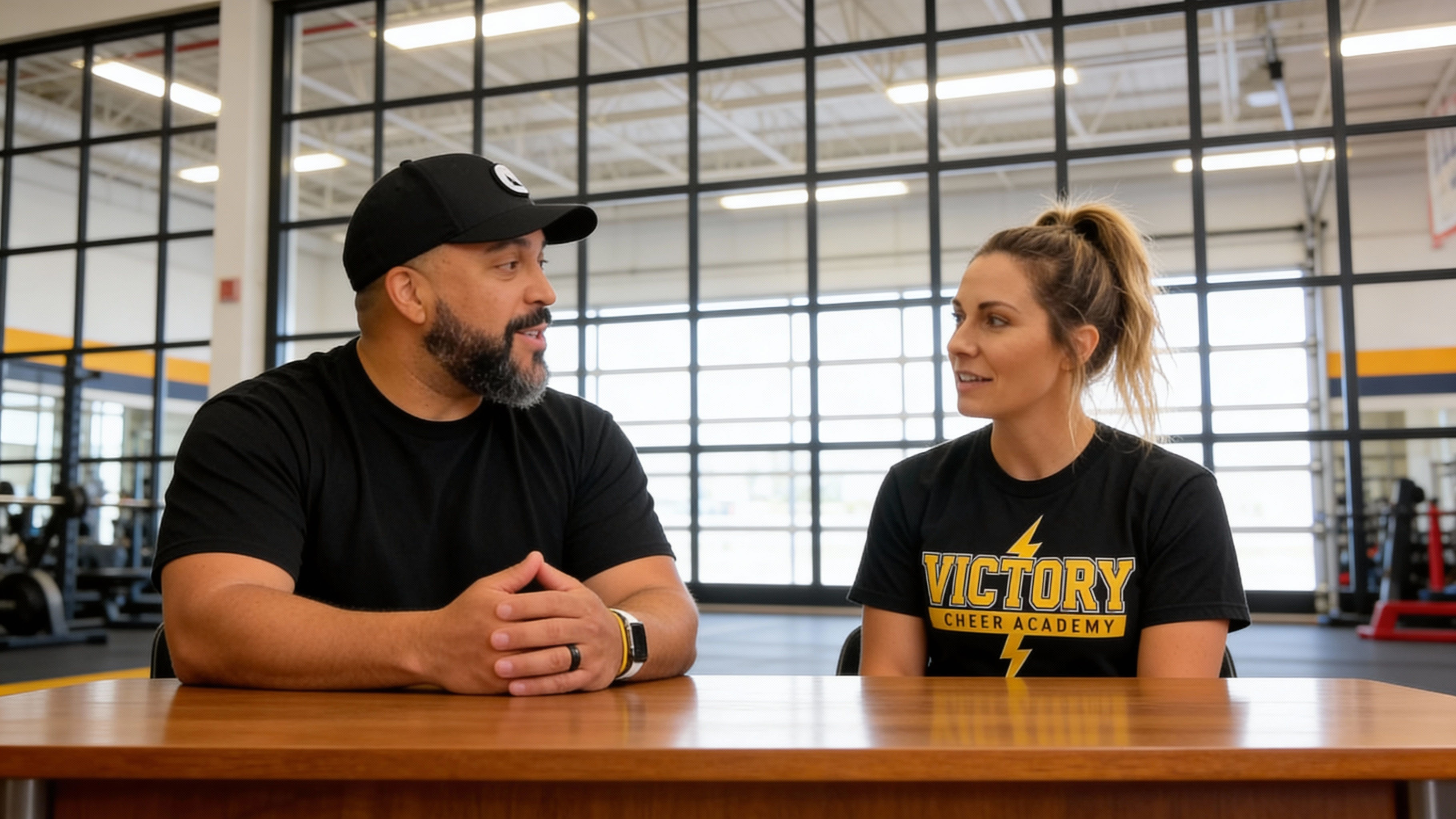
One of the most common conversations I have with gym owners, coaches, and even parents revolves around culture.
Not skills.
Not routines.
Not even results.
Culture.
Because if you’ve been in All-Star cheer long enough, you know this truth: a program can have talent and still feel fractured. It can win and still feel disconnected. It can grow and still feel unstable.
And more often than not, when something feels off, people start pointing at individuals.
“That parent is always an issue.”
“That athlete just doesn’t get it.”
“That family doesn’t fit here.”
But what if we’re asking the wrong first question?
From “What’s wrong with them?” to “Are they aligned with us?”
It’s easy to label people. It’s harder—and far more productive—to evaluate alignment. Instead of defaulting to “that’s just how they are,” a better question is: Is this person a good cultural fit for what we’re building here? That question changes everything.
Because sometimes the issue isn’t that someone is difficult. It’s that they’re in an environment that doesn’t match their expectations, values, or needs. And when that mismatch exists, friction is inevitable.
This is something Simon Sinek talks about often. People don’t struggle in a vacuum—they struggle in environments that either support them or work against them.
The myth of the “unmotivated athlete” (or parent)
Another trap we fall into is labeling people as “unmotivated.” But motivation isn’t that simple.
Sinek breaks this down through the lens of intrinsic versus extrinsic motivation. Some people are driven by internal purpose, growth, and connection. Others rely more heavily on external rewards, pressure, or outcomes.
When someone appears unmotivated, it’s easy to assume it’s a character flaw. But what if it’s not?
What if:
- They don’t feel seen or understood?
- They’re overwhelmed or unprepared?
- They don’t feel psychologically safe?
- They don’t actually connect with the culture they’re in?
In those cases, the issue isn’t necessarily the person. It’s the environment.
You shouldn’t have to convince people to belong
This is one of the most important shifts a program can make.
If you constantly feel like you’re trying to convince athletes or parents to buy in, you’re already fighting an uphill battle. Instead of asking, “How do we motivate them?” the better question is: “Are we creating something people feel inspired to be part of?”
Because there’s a difference between compliance and commitment.
You can pressure someone into showing up. You can incentivize effort. You can enforce rules. But you cannot force someone to care. That comes from connection. That comes from belief. That comes from culture.
Culture is built through clarity, not control
A welcoming, productive culture doesn’t happen by accident. It’s built through clarity.
Clarity of:
- Values
- Expectations
- Communication
- Standards
When people know what your program stands for, it becomes easier for the right people to lean in—and for the wrong fit to naturally filter out.
And that’s not a bad thing. Not everyone is meant for every environment. The goal isn’t to make your program work for everyone. The goal is to make it work deeply for the people who align with it.
What this means when challenges show up
Let’s go back to the “problem parent” or the “difficult athlete.” Instead of immediately labeling or reacting, consider a different approach:
- Have we clearly communicated what our culture stands for?
- Do they understand what’s expected of them?
- Do they feel seen, heard, and supported?
- Or are they operating from confusion, fear, or misalignment?
Sometimes, a conversation can bring someone back into alignment. And sometimes, it reveals that they were never aligned to begin with.
Both outcomes are useful.
The role of leadership
Culture is not what you say—it’s what you tolerate, reinforce, and model every day.
Athletes watch how coaches respond under pressure.
Parents watch how communication is handled.
Staff watch what behaviors are rewarded versus ignored.
If you want a culture that is:
- Welcoming
- Accountable
- Supportive
- Growth-oriented
Then those qualities have to be consistently demonstrated at the leadership level. Not occasionally. Consistently.
Final thought
A strong culture doesn’t require constant convincing. It attracts. It aligns. It retains the people who believe in it—and naturally repels the ones who don’t. And when you build a program like that, something shifts.
You spend less time managing conflict and more time developing people. Less time forcing buy-in and more time deepening it. Less time questioning who belongs—and more time building something meaningful with the people who do.
Because the goal isn’t just to build a successful program. It’s to build a place people are proud to be part of.